Old Oakville is the neighbourhood most people picture when they think of Oakville: tree-lined streets of heritage homes, a lively downtown along Lakeshore Road, and the harbour where Sixteen Mile Creek meets the lake. It's also one of the most established and sought-after addresses in the city. Here's a closer look at what it's like to live there.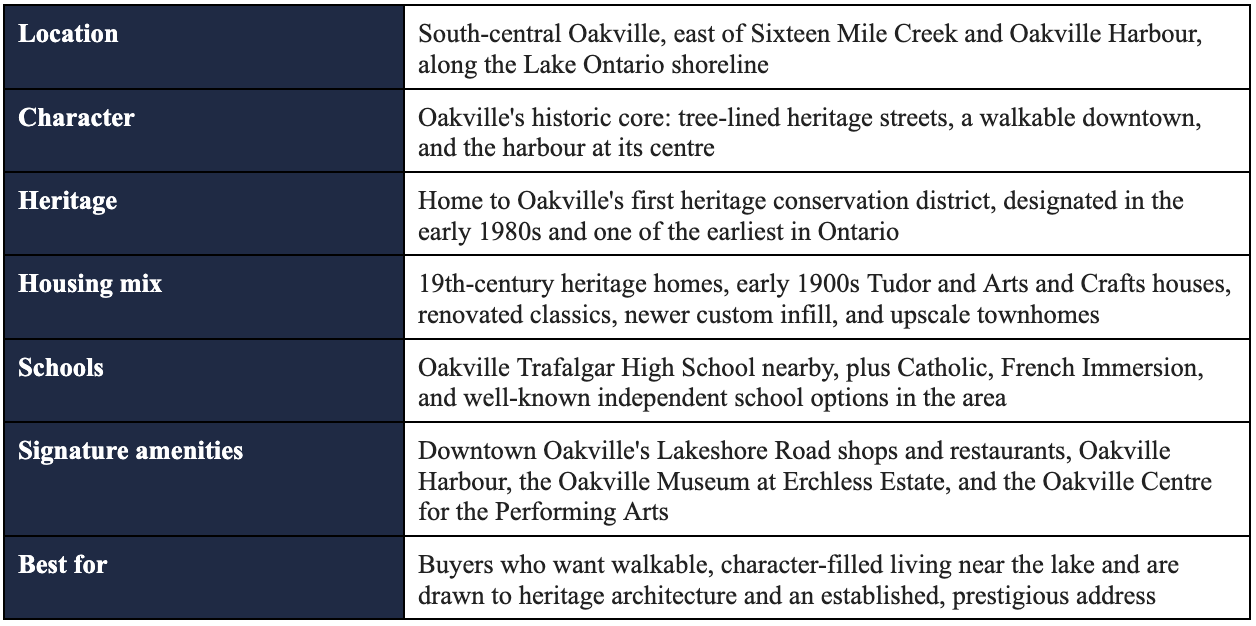
Old Oakville sits in the south-central part of the city, just east of Sixteen Mile Creek and Oakville Harbour, with Lake Ontario along its southern edge. This is where Oakville began. The town grew up around the harbour in the 1800s as a shipbuilding and trading port, and many of the homes still standing today were built by the shipbuilders, merchants, and tradespeople who made it work. Historical society plaques throughout the neighbourhood mark houses tied to those early families. That history is protected on purpose. Old Oakville was home to the town's first heritage conservation district, designated in the early 1980s and one of the earliest of its kind in Ontario. Today it's one of several heritage districts in Oakville, alongside First and Second Street, Trafalgar Road, and Downtown.Architecture is the protagonist here. Old Oakville's streets mix 19th-century vernacular homes with Georgian, Neo-Classical, Victorian, and Classical Revival designs, along with early 1900s Tudor and Arts and Crafts houses. Many have been carefully restored or thoughtfully expanded, and they sit beside newer custom infill homes built to fit the character of the street. Closer to downtown, upscale townhomes offer a lower-maintenance way into the neighbourhood, while the stretch of Lakeshore Road east of downtown includes some of the city's most impressive lakefront estates. Because homes here vary so much in age, size, lot, and condition, pricing varies widely too. Comparable sales on a specific street usually tell you far more than a neighbourhood-wide average would.If you're buying within a heritage conservation district, it's worth understanding what that designation means before you fall in love with a renovation plan. In general, exterior changes such as additions, new windows, porches, or demolition need heritage permit approval from the Town of Oakville, and plans are reviewed against the district's guidelines. Interior renovations are typically not affected in the same way. For most buyers this is part of the appeal: the same rules that limit what you can change also protect the character of the street around you. Still, it's worth confirming whether a specific property falls inside a district boundary, and what the guidelines allow, with the Town's heritage planning staff before you firm up an offer.Old Oakville is well served by both public and Catholic schools, including Oakville Trafalgar High School, along with French Immersion programs and several well-known independent schools in and around the area, including St. Mildred’s-Lightbourn School and Linbrook School. As always, catchment boundaries can change, so confirm the assigned school for any specific address with the Halton District School Board or the Halton Catholic District School Board.Few neighbourhoods in Oakville are as walkable. Downtown Oakville's stretch of Lakeshore Road is lined with independent shops, cafés, and restaurants, and much of daily life can happen on foot. The harbour is the neighbourhood's backyard, with waterfront parks, the Oakville lighthouse, and walking paths along the lake and the creek. Culture is close by as well. The Oakville Museum operates at Erchless Estate on Navy Street, the 1850s home of the Chisholm family, one of the town's founding families. A short walk away, the Oakville Centre for the Performing Arts sits right on the harbour, with a 470-seat main theatre and a smaller studio theatre hosting concerts, theatre, and touring shows throughout the year.Oakville GO station is a short drive or bike ride north of downtown, putting Union Station within easy reach by train, and the QEW is close by for drivers heading to Mississauga, Toronto, or Hamilton. For many residents, though, the real appeal is how little they need to drive at all once they're home.Old Oakville suits buyers who want character and walkability more than square footage: people drawn to heritage architecture, a real downtown at the end of the street, and the lake a few minutes away on foot. It attracts established professionals, families who want an older home with history, and downsizers who want to trade a big suburban property for something smaller in the heart of town. Buyers looking for brand-new construction or a large modern lot for less money will usually find better value further north.Buying in Old Oakville often means looking closely at a home's age, condition, heritage status, and how it compares to recent sales on the same street. We know these blocks well. If you're thinking about buying or selling in the neighbourhood, reach out and we'll walk you through what's available and what it's worth.